National Time and Frequency Standard
The fundamental unit of time, the second, and its dual quantity, frequency, are currently defined as a fundamental physical unit in the SI system. One second is the duration of 9,192,631,770 periods of electromagnetic radiation corresponding to the transition between two hyperfine levels of the ground state of the cesium-133 (¹³³Cs) atom at a temperature of 0 kelvins. This definition is maintained worldwide with the highest accuracy by several primary laboratory-type standards and a large group of industrial (commercial) atomic clocks. The long-term stability of the standard value of the unit and frequency of these commercial types is better than 10⁻¹², ensuring time and frequency metrology at the highest level for all required sectors of society. This is particularly relevant for modern telecommunication technologies, certain special measurement applications (such as military technologies), and research-related equipment.
The functionality and precision of time and frequency metrology in any country that possesses atomic clocks are primarily ensured through the organization of the time section at the BIPM in Paris.
This understanding implies that participation in comparative measurements, which are conducted continuously, guarantees that time and frequency metrology in a given country remains at a world-class level. This is currently the case in Slovakia, as the results of comparative measurements and ongoing participation in the creation of world time at BIPM are documented for the national time and frequency standard of the Slovak Institute of Metrology (SMU), which continuously generates the time scale designated as UTC(SMU) at BIPM.
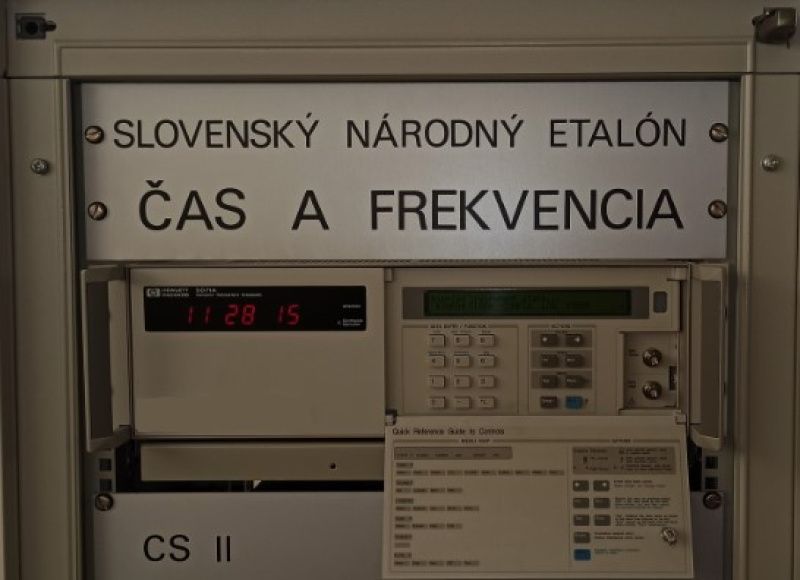
The National Time and Frequency Standard, NE No. 004/97, is an HP 5071A device, purchased as a finished product. Thus, it can be stated that, along with the established storage conditions in a specialized SMU laboratory, the technical implementation of the national standard is complete, and the required conditions for its operation have been met.
To ensure the acceptability of the standard value, a system for continuous comparative measurement with BIPM has been established via the GPS and Glonass satellite systems, using a TTS-3 GPS/Glonass receiver and a two-way transfer of measured and resulting values via the internet.
Comparative measurements are conducted daily (continuously), and the measurement results are sent to BIPM at weekly intervals. The confirmation of the national standard’s values is published in the Circular-T monthly reports.
Documents for download
-
Osvedčenie (certifikát) (pdf, 1.1 MB)