
National Standard of Electrolytic Conductivity
Electrolytic Conductivity
Electrolytic conductivity is a physical quantity that characterizes the electrical properties of electrolyte solutions. The unit of electrolytic conductivity is siemens per meter (S/m), which can be interpreted as the conductivity of a cube with a 1-meter edge filled with the measured solution, where two opposite faces act as first-class conductors made of an inert material that does not chemically react with the solution.
Applications of Electrolytic Conductivity
Electrolytic conductivity is widely utilized wherever a solution contains ionogenic substances. Its applications span various fields, including:
- Chemical industry,
- Environmental monitoring,
- Healthcare,
- Oceanographic research (such as determining sea salinity).
Measurement of Electrolytic Conductivity
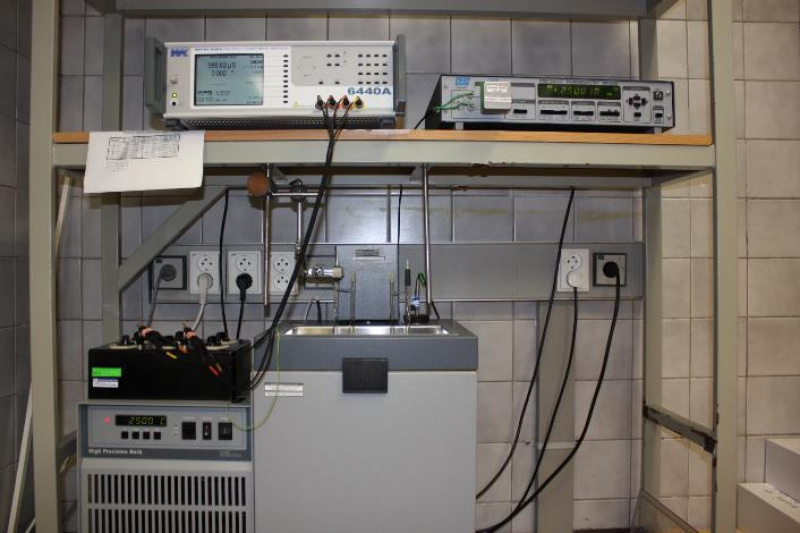
Electrolytic conductivity is determined by measuring conductance (conductivity) in specialized measuring cells, whose geometric parameters are precisely known. This ensures high accuracy and reliability in various scientific and industrial applications.
Documents for download
-
Osvedčenie (certifikát) (pdf, 678.6 kB)