
National Standard of Electrical Resistance
The International System of Units (SI) and Electrical Quantities
The International System of Units (SI) is based on seven fundamental units defined using the latest scientific advancements. Among these, the ampere is the fundamental unit for electrical quantities. Other electrical units used in measurement technology are derived from the fundamental units using valid physical laws. The only exception in their derivation is the unit of electric current, the ampere.
In current metrological practice, electrical units are derived from the unit of electric voltage – the volt, and the unit of electric resistance – the ohm. This is because the units of electric voltage and resistance can currently be realized with far greater precision than the unit of electric current. Both phenomena, the Josephson effect for electric voltage and the Hall effect for electric resistance, are observed in low-temperature experiments below the boiling point of liquid helium (4.2 K).
The Quantum Hall Effect and the Standard of Electrical Resistance
In the case of the electrical resistance standard based on the quantum Hall resistance, the discovery was made by von Klitzing in 1980, for which he was awarded the Nobel Prize. A key feature of the phenomenon is the formation of a stable plateau in the relationship between Hall voltage and the induction of the external magnetic field. The ratio of the Hall voltage to the current corresponds very precisely to the ohmic value of 25,812.807 Ω, which can be divided by an integer corresponding to the respective plateau used.
National Standard of Resistance
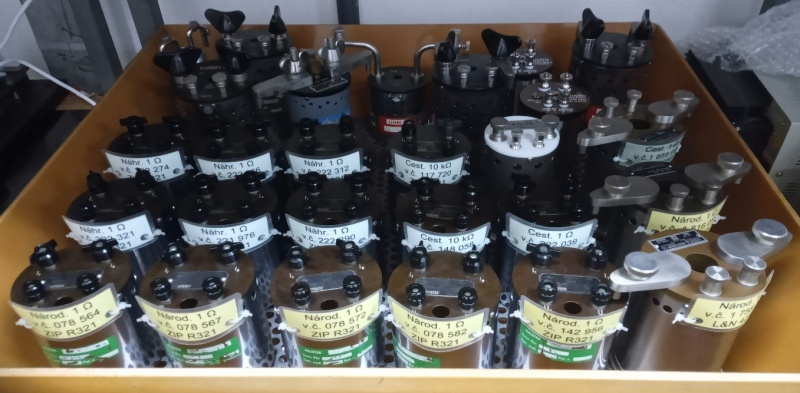
The National Standard of Resistance consists of:
- A set of seven 1-ohm resistance standards.
- Three 1-ohm traveling standards.
The national standard is permanently housed in laboratory H149 and is regularly calibrated at the BIPM using the traveling standards. All relevant parameters of the national standard are monitored regularly.
This ensures the accuracy, traceability, and compliance of the national standard with international requirements for precision in electrical resistance measurements.
Documents for download
-
Osvedčenie (certifikát) (pdf, 1.5 MB)