
NE 014/98
National Standard for Electrical Capacitance
Content
The farad (F), or more precisely its subunit 10 pF, is realized and maintained through a group standard. This serves as the foundation for establishing a capacitance scale that extends from fractions of a picofarad (pF) to large capacitance values in the microfarad (µF) and millifarad (mF) ranges.
Measurement and Frequency Range
- The required measurement frequency range typically extends up to 20 kHz, with a focus on achieving the highest measurement accuracy at 1 kHz and 1.592 kHz (ω = 10,000 s⁻¹).
- For power industry applications, measurements are often required at 50 Hz, typically at high voltages reaching several kilovolts (kV).
Applications and Importance
The capacitance unit and its scale provide the basis for transferring the unit to:
- Standard capacitors
- Capacitance decades
- Capacitance references
- Capacitance measuring instruments (capacitance bridges, RLC meters, certain types of multimeters)
- Impedance bridges
- Measurement of parasitic properties of resistors and inductors carrying AC currents
Measurement Methods at SMU
At the Slovak Institute of Metrology (SMU), the capacitance value and dissipation factor of capacitors are determined using:
- Direct measurement methods
- Direct comparison methods
- Direct substitution methods
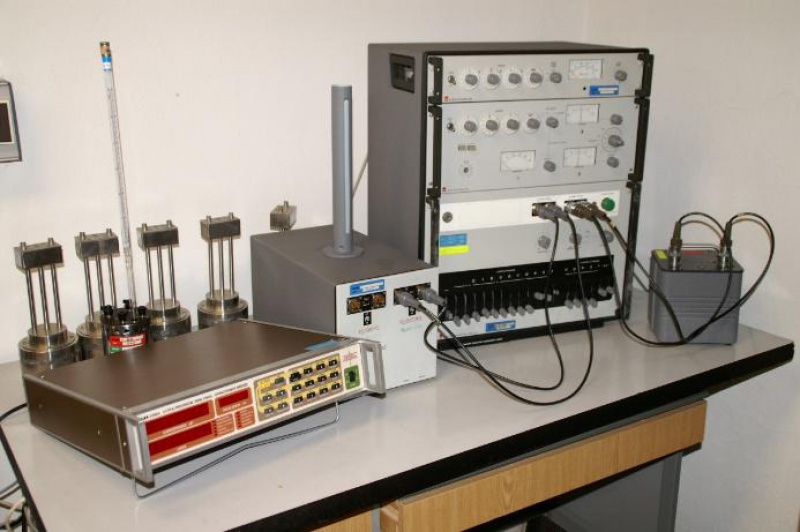
For high-precision capacitance measurements, SMU utilizes an ultra-precise capacitance bridge, the Andeen Hagerling AH 2700 A.
Primary Capacitance Standards at SMU
The primary standards of electrical capacitance at SMU consist of:
- Two capacitors with a nominal value of 10 pF, designated as GR1408, housed in an air thermostat.
- Manufactured by General Radio Co., USA, these standards are directly traceable to BIPM (Bureau International des Poids et Mesures).
Documents for download
-
Osvedčenie (certifikát) (pdf, 242.3 kB)